


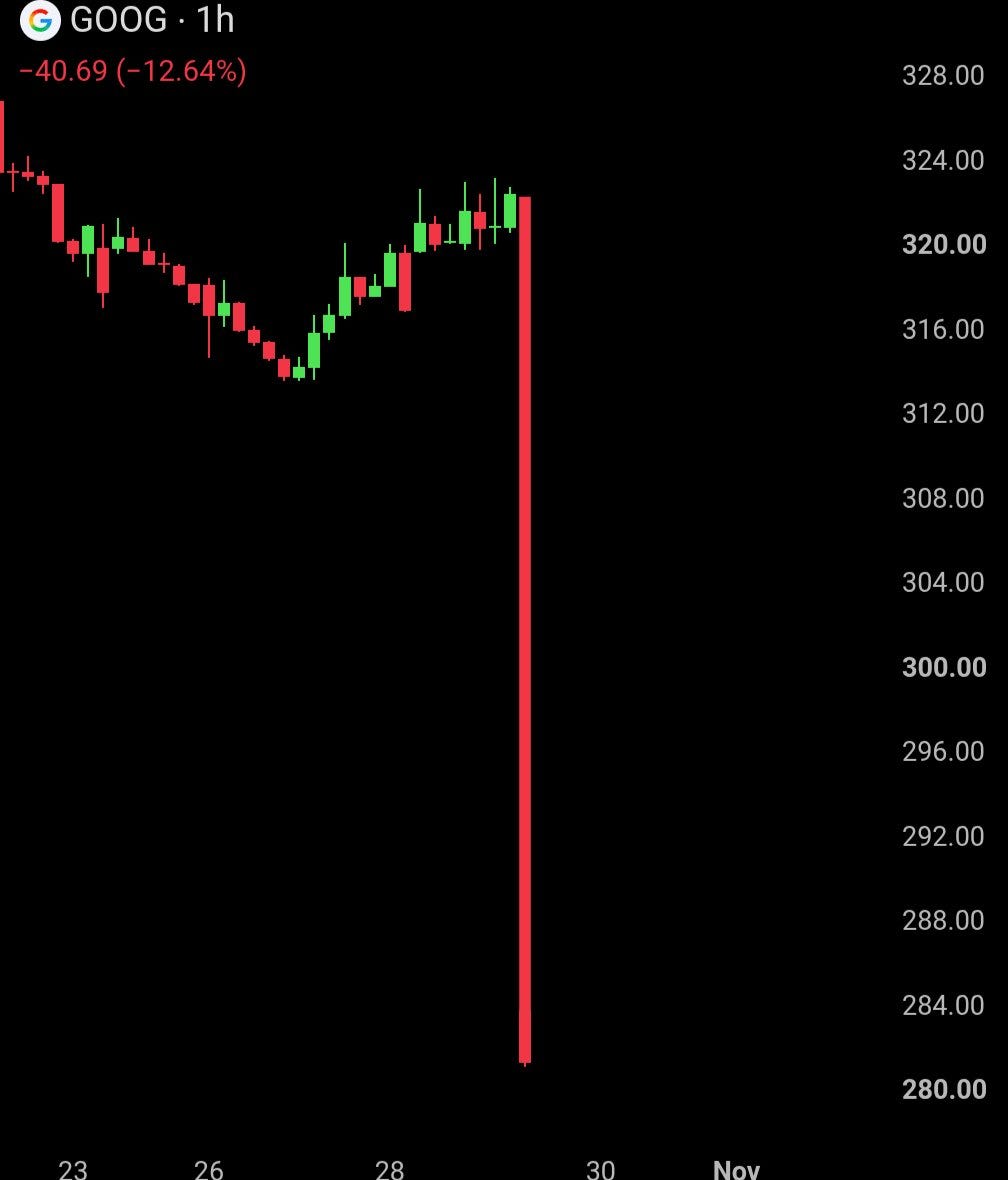
Google’s valuation fell today around 13%.
That’s about USD$480 billion from its market cap, 3.5 times its revenue in the entire last quarter.
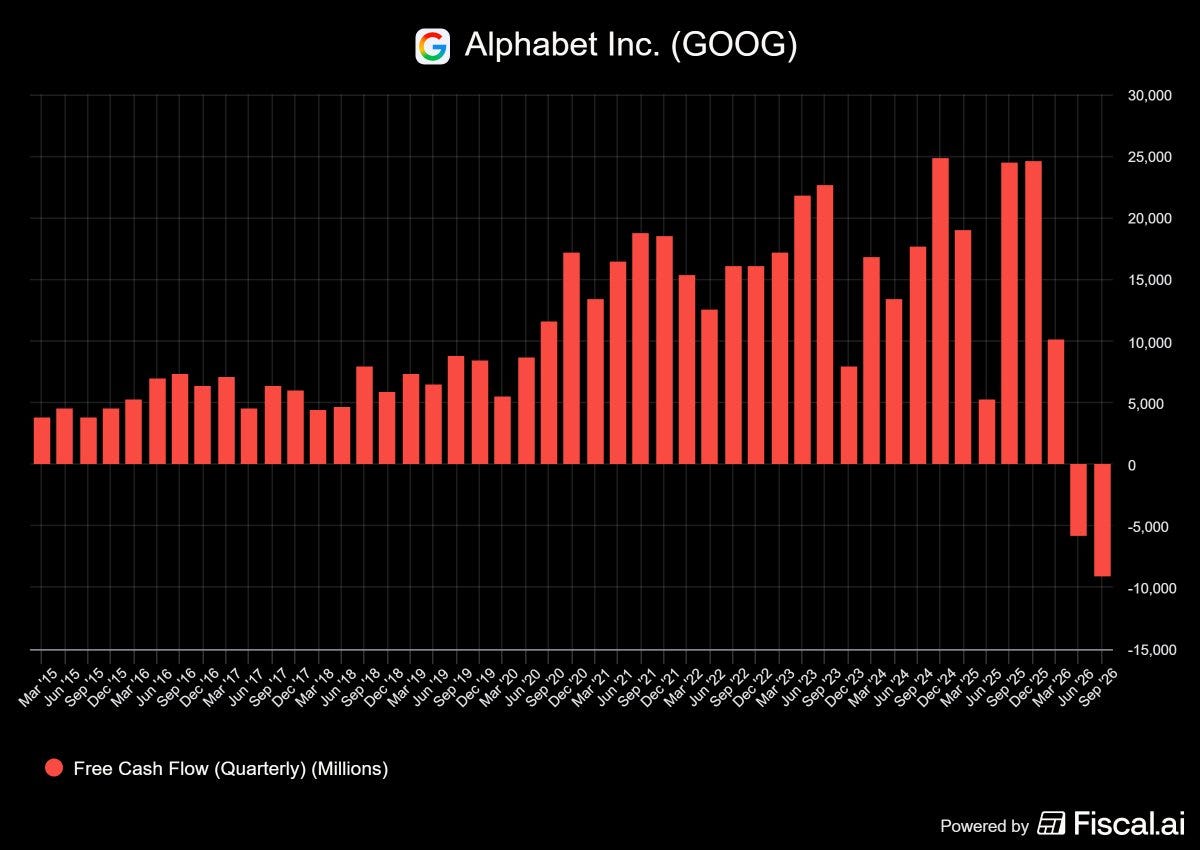
It’s free cash flow went negative: from USD$10.1B in Q1 2026 to USD$ -9.1B in Q3 2026.
And the market reacted.
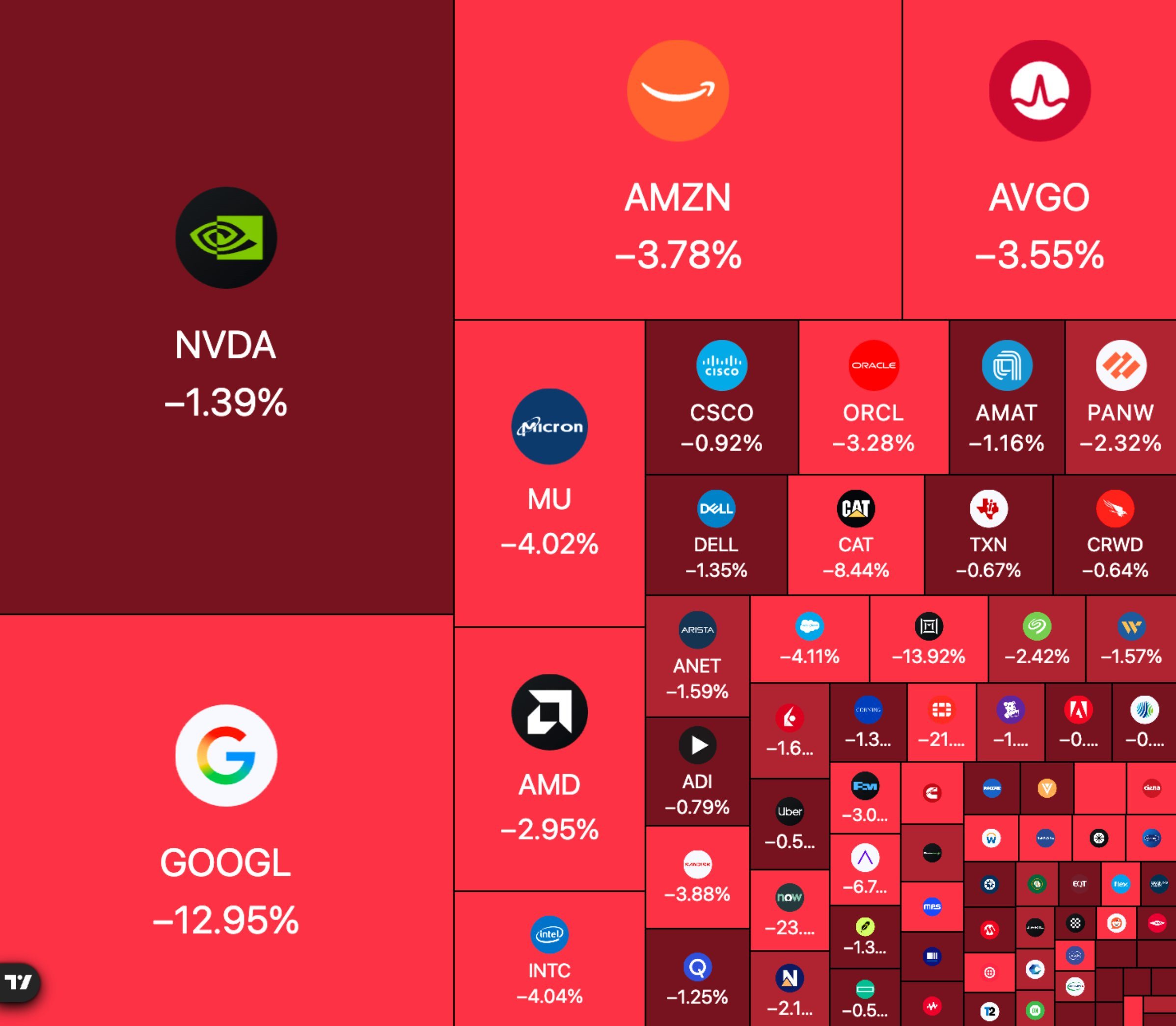
But, why now?
Alphabet missed on earnings for the first time in four years.
This doesn’t mean they actually lost money.
They just didn’t grow as much as everyone was expecting.
Search revenue only grew 12%, down from 17% in Q2 2026 and 19% in Q1 2026.
And even if Search usage has been steadily growing quarter after quarter, Search revenue has not.
Why?
The short answer is AI.
Google is trying to convert its main business from Ads-on-Search focused into Ads-on-AI-Results instead.
And so far they haven’t been able to place as many ads now that AI is involved as they did before when people just obtained results from the Search Engine.
The process is proving to be a bumpy one.
All of this might lead you to think this is bad for Google.
But I say it is not.
And to understand this, you must remember what happened with Kodak back in the 2000s, when it went bankrupt after peaking at USD$30B at some point.
If you have ever stepped into a Business School or similar class, I’d be 100% certain that you have read and discussed the Rise and Fall of Kodak.
The story is pretty simple.
Kodak was the leading company regarding everything Photography: films, film developing chemicals, photo paper, and even camera and lenses technologies.
Kodak was everywhere.
Of course they had a lot of competition, but Kodak reigned supreme.
Then, something happened.
Somewhere, in a dark and secluded secret lab in some Kodak building, a group of scientists and engineers came up with something marvelous: Digital Photography.
You no longer needed either films, chemicals, paper, or any of the existing camera technologies.
You just clicked and got your image stored in some computer memory, where you could send it later to print or whatever.
What did Kodak do with their new and revolutionary invention?
They basically shelved it under 7 holy seals and put Cerberus to guard the door.
Why?
Because ALL of their revenue basically depended on film and everything related to it.
And going digital would have killed their revenue sources almost overnight.
But what happened next was all too predictable: someone else came up with the same idea, mass produced it, and sent Kodak to the grave.
Kodak didn’t want to embrace the new technology, as it would fiercely cannibalize their existing revenue sources.
So they hid it.
And someone else ate their lunch.
As I said, every Business School teaches this case, and every armchair general since then has always said: “Kodak should have found a way to cannibalize themselves with digital photography, instead of letting others do it”.
Well… that is what Google just did.
They seem to have learned the hard lessons from Kodak, and they are unwilling to let OpenAI and friends to eat their lunch.
So they are cannibalizing their own Search Engine business with their AI-Search business, and hoping to find the magic trick, the perfect balance, before anyone else does it.
Something important to consider are the current Google (Alphabet) revenue sources.
Google started (as usual) in red, by providing free searches over the ever growing mass of Internet data and documents.
Later they monetized this service by providing ads who were perfectly targeted by the search itself: what better way to know what someone is needing right now than receiving from them a search query about it.
But to process those inconceivably enormous amounts of data, and serve them back to an also inimaginable huge audience, real-time, and 24/7, you needed a lightning fast worldwide network and compute capacity to match.
So Google also became an expert on globally distributed computing, and sooner than later they realized they could also rent that expertise to every business in need of processing power and global reach.
Add to this some Software as a Service, like Gmail, and the Google Workspace Suite to name a few.
Now they are one of the leading developers of AI (not to mention that the whole GPT thing was born at Google), and are trying to build a strong business case of AI mixed with everything else they have in their portfolio.
Are they going to succeed where Kodak failed?
Well, we are not future-tellers, but I’d say they are well prepared to do so.
First of all: they are doing something.
They are not hiding the tech in the basement, waiting for someone else to rediscover it and destroy them.
Their actions show that they are conscious of the risks, and willing to sacrifice short term revenue for the sake of the future dominance on AI Search.
You don’t see that often.
Second: they are in the perfect position to do so.
Who else has all the data about what everyone has searched in the Internet for the last 20 years? (yes, down to the single data point, and that means Google knows what YOU have searched during the last 20 years).
But not only the data, also the computing and networking power, decentralized all over the world.
And third: the staff and scientists.
They have the cash, financial backing, personnel, and resources they might need to pivot once and again until they find the secret recipe to solve the current puzzle.
People used to just go to the search engine, input a query, and then Google would inject amongst the results a list of businesses and products that were perfectly tailored for what you were searching.
No guessing there. Perfect ad placement.
But now people go to the search engine with vague ideas, and interact with the AI-powered Search Engine, until they find what they need.
AI usage goes up. Searches go down.
So less ad placement. Less revenue.
But higher operational costs.
Hence, 9 billion negative free cash flow.
How is Google going to fix this conundrum? It is up to them, and I’m sure they have hundreds or thousands of people working on it.
So, my bet would still be on Google’s ability to turn this around and reign supreme at least a few years more.
Unlike Kodak.
Poor Kodak.
Conclusion
Today’s episode shows something I’ve been saying like forever: it really doesn’t matter what your Profit Model today is (the way your business makes money), it is going to change during the Age of AI.
And the Age of AI is already here.
Even Google needs to revise how they are making money, and adapt or follow Kodak, Blockbuster, and others into the graveyard.
We should learn something from it.
So check my publication often, as I show you there how your business should approach the changes that are upon us.
Thank you for reading my publication, and if you consider it helpful or inspiring, please share it with your friends and coworkers. I write weekly about Technology, Business and Customer Experience, which brings me lately to write a lot also about Artificial Intelligence, because it is permeating everything. Don’t hesitate in subscribing for free to this publication, so you can keep informed on this topic and all the related things I publish here.
As usual, any comments and suggestions you may have, please leave them in the comments area. Let’s start a nice discussion!
When you are ready, here is how I can help you:
By subscribing to my publication and reading this article you have already taken the first steps into redesigning your business to succeed during the Age of AI, .
But if you want to go further, here are several options:
If you want to start right away, you can join me in my 3-day Future-Proof Entrepreneur Challenge, where you will learn how to analyze your Profit Model (how your business makes money today), look around for the Exponential Technologies you will need to make it work in the Age of AI, and finally create a plan to make it happen.
You can check my FREE guide “7 Profit Models to Succeed in the Age of AI”.
And also my FREE guide “7 New Technologies that can wreck your Business like Netflix wrecked Blockbuster”.
The Entrepreneuring AI is free today. But if you enjoyed this post, you can let me know that my content is valuable by fueling my coffee addiction, so I can keep producing it for free 😸☕️