


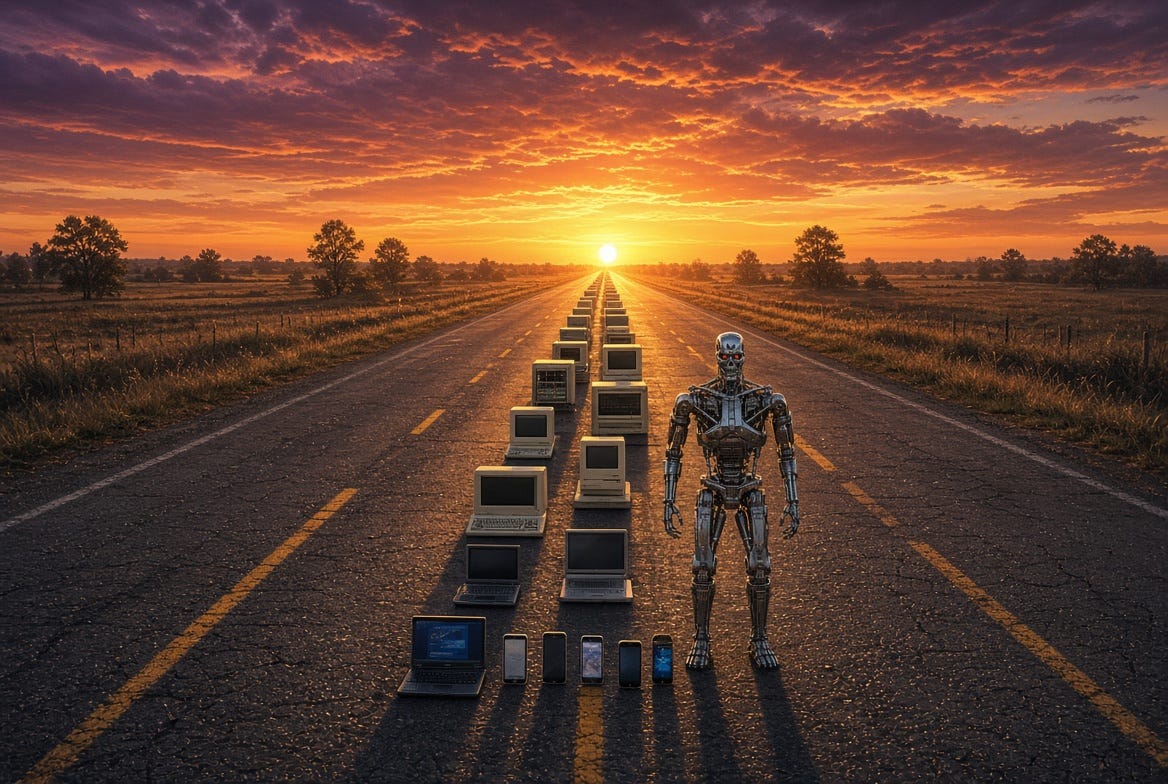
When you think about AI today, probably the first sentiments that come to you are a combination of hype and anxiousness.
The big AI vendors were first trying to sell you the idea that the current AI was really close to becoming equal (and soon surpass) to the human intelligence.
Of course, this is not going to happen (and I will discuss it in depth in another article later).
Now they are trying to convince governments that AI has become so powerful and such a dangerous tool, that it should be expropriated by them, giving the AI vendors a comfy escape from the mountains of debt they have accrued without having a real business model to back it.
And I will also discuss this in depth in another article later, of course.
But all of this noise obscures the real path our current AI is following, making difficult for the untrained eye to take sound decisions for their businesses.
I’m blessed to have a very diverse background: as a Software Engineer I have been always more interested in the Computer Science part of it, dabbling with Artificial Intelligence as early as 1999, then Project Management once I graduated, then 20+ years of Technology Entrepreneurship, and recently an International MBA to round it up with a deep understanding of the Economics behind all of this.
This gives me a unique perspective on how AI is evolving, in comparison to many different previous computing technologies, and has helped me develop an intuition on the direction we are going, both short and long term.
This article is intended to share with you this intuition, so you can take it as a starting point to develop your own business strategies to succeed in the Age of AI.
In Today’s Issue:
How Did We Get Here in the First Place: Our current AI technologies didn’t spawn out of thin air, so it is useful to understand how we got here.
It Has Happened Before, and It Will Happen Again: Understanding the development of other comparable technologies can help us understand where AI is going now.
The Open Source Factor: The battle between the Cathedral and the Bazaar has never been more relevant.
The Future of AI and the Singularity: What can we predict about where AI is going, based on what we have already analyzed.
How Did We Get Here in the First Place
To understand where AI is going, we need to first have a good idea of where it comes from.
Only then we will be able to see the parallels between AI technologies and other computer technologies that followed the same path.
AI is not new. We have been doing research on it since the 1950’s.
And, as with everything Science, we have not always pursued the same strategies for achieving AI.
Initial efforts were greatly constrained by the memory and computing capacities of the era.
We went from trying (unsuccessfully, of course) to reduce the world to mathematical formulas a computer could process.
It was named the Logical-Symbolic AI era.
We failed at reducing the world to formulas, but in the process we developed powerful search algorithms and concepts that are still fundamental to our current AI efforts.
Then came the Expert Systems AI era.
We tried find a better way to represent knowledge in what were the all new relational databases, and create reasoning engines capable of deriving new knowledge from existing data, and the input from human experts.
Still far from what we know today as Reinforced Learning (when a machine learns by doing, getting it wrong, and then being told it was wrong and why, so it can try better next time).
Then the Neural Networks AI era came.
We stopped trying to tame the real world to make it more palatable for computers, and instead started to try to model the human brain, and how it learns and processes things.
But our computing power was still vastly insufficient, so it failed again to produce any meaningful results.
Then, thanks to some clever algorithms (like the Generative Pre-trained Transformers, or GPTs) and the development of massively parallel computing capacities (thanks to the GPUs that power today’s gaming computers and consoles), we saw for the first time a neural network capable of performing comparably to humans in very specific tasks.
All this process took more than 70 years not only because it was a hard scientific problem to solve, but also because of the inevitable hype cycle.
Imagine this: some clever egghead back in the 1950’s explained what an Artificial Intelligence could do for mankind to a wealthy businessman, CEO, etc.
They, of course, understood the potential and wanted to be the first to have one, then poured ungodly amounts of money on AI research to get it done.
Others followed suit.
But the problem was still beyond what could really be achieved with the technology of their time, so they predictably failed.
So, they felt cheated and, of course, blamed the Science instead of accepting they were gambling their money without really understanding the problem.
So they angrily shut their wallets to anything related to AI for two decades or so, probably kicking out the door anyone who approached to them talking about it.
Those guys eventually retired, then someone else fell for the next AI paradigm, and the cycle repeated.
We call those periods of slow progress The AI Winter periods.
The AI industry has suffered several AI Winters so far, and I fear we might get another one after all of this LLM craze (but probably this also deserves another article on itself).
Now that we have some understanding of how current AI came to be, we can explore other technologies that followed a path that might be comparable.
It Has Happened Before, and It Will Happen Again
Now, let’s think about how computers themselves came to be, and how computing itself evolved over time.
We might to be able to see ourselves somewhere in the middle of that roadmap, like those useful You Are Here informational maps.
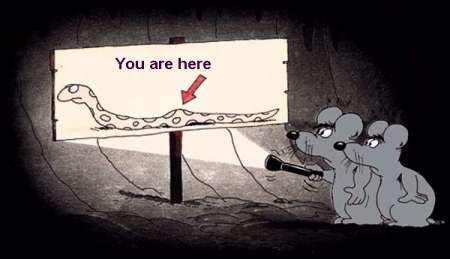
Computers started like enormous machines, built using vacuum tubes very similar to our ancient light bulbs.
They required tons of maintenance and entire engineer teams to keep them up and running.
Let’s not even talk about memory… that thing didn’t even exist yet as we now understand it.
And, of course, their computing power was pitiful when compared to today’s even simplest wall clock or home appliances (with some processing power).
But, like with the story about AI, we started setting some important milestones and design principles that we use even today in our more advanced frontier computers (like the von Neumann computer architecture, but talking about why using it for AI is hindering progress would also require an article on its own, so let’s leave it for later).
To recap, we started big, slow, ugly, power hungry, expensive, requiring a lot of manpower, and very specialized knowledge to operate.
Nevertheless, visionary US companies like IBM embraced the whole idea of computing, and turned them into enormous standardized products that equally enormous organizations could purchase and operate on their own.
But for most people and organizations, owning your own computing was so expensive that you had to rent it by the hour to those companies that had made the capital investment to have computers.
So you paid subscriptions to access a computer to do your work.
Yeah.
Where have I seen that recently… I can’t remember.
Anyways, there is a widespread (and wrong) quote attributed to Thomas Watson Sr., the man who named IBM as IBM: “I think there is a world market for maybe five computers”.
It might be a misunderstanding of a real quote, but it gives us an idea of what were in the minds of the top people related to computing back then.
“I think there is a world market for maybe five computers.”
— Thomas Watson Sr., first CEO of IBM? Really?
Then hobbyists (literal people in their garages buying issues from Popular Mechanics) started building their own computers at home.
This, of course, previously required a lot of advancement in miniaturization of components, the development of circuit boards, cheap LED technology, etc.
This means, hardware became accessible.
And also advancement on programming paradigms, the invention of some early programming languages, etc.
Software to go with the hardware.
But the whole idea of a computer at every home didn’t exist yet.
Until it happened.
Someone said: “I think every house will have at least one computer”.
And, for sure, everyone laughed at him at the time.
But we know what happened in the end, right?
So, the Personal Computer came to be.
It still was expensive, not very powerful, required quite some skills to use it, but more than enough people started having one.
Ringing a bell yet about AI?
No?
Ok, let’s continue then.
Suddenly, we had lots of Personal Computers, not only at homes, but also as part of organizations that started to buy them by hundreds and thousands.
Networking became the next predictable development.
Making computers connect with each other so they can share resources, information, etc.
Then the Internet came, and computers no longer were constrained to being connected inside a single organization, but a worldwide, resilient, and fault tolerant network was built.
And finally the hardware miniaturization and software optimization made possible the development of truly personal computers (smartphones) and even wearables (smartwatches and smart glasses).
So now we can say we have more than one computer per person.
Who would have imagined that in the 1950’s, right?
The Open Source Factor
If you have been following the idea, probably you have realized by now that we are still in the era where AI-related stuff are big, expensive, power hungry, requires lots of engineers, and a PhD in Computer Science.
Nevertheless we already have people at their garages, buying a dozen of Mac Minis, or some of the newest NVIDIA’s DGX Spark AI-specialized computers, or their AMD competition, the Ryzen AI Halo.
And they are working hard to create AI systems capable of working offline, without the need to pay expensive subscriptions to the big AI vendors like OpenAI, Anthropic, etc.
But creating AI models from scratch is something a guy at his garage cannot achieve by himself: not only it requires some advanced math knowledge, but also tons of computing power and even more tons of DATA to feed the insatiable LLMs (Large Language Models, that are properly tagged as LARGE for some reason).
So this is where the now famous Open Source AI Models come in.
First, let me quickly explain what Open Source Software is.
Let’s go back to our story about how computers came to be.
Remember that point between the guys at their garages building their personal computers from parts they purchased at Radio Shack, and the moment companies like Apple, IBM, etc. started selling assembled and ready to use Personal Computers so everyone had one at home?
Ok, right in the middle there was a heated discussion in the hobbyist community about how software should be developed and how to attribute rights to their creators and the ability to profit from it.
This discussion shaped the software industry as we know it today.
You see, in the beginning, smart guys in the hobbyist communities not only built their computers, but also created the operating systems for those computers they built.
And they met every week at someone’s home or garage, to show what they had built, and brag about it.
So everyone present was awed by the progress, but also came out with new ideas they immediately implemented in both their hardware designs (they redesigned and rebuilt their computers) and also the software that controlled it.
And of course, they went the next week to show it to the community and brag about it.
You might be surprised, but this is how both computer hardware and software design advanced so fast in the late 1970’s and early 1980’s.
Nobody was charging money for their ideas, for both hardware and software, to the attendants to those meetings.
Ideas flowed freely and science pushed forward at full speed.
Why would you charge for something that was already 95% coming from ideas taken from your predecessors?
Or at least, that was the logic behind that sharing model.
Until a clever (and apparently greedy) guy wrote a famous open letter to the hobbyists, telling them they were all wrong, that software should be protected by Intellectual Property rights, like books and art were, and they should be profiting from their work instead of giving it out for free.
Of course this guy’s name was William Henry Gates III, also known as Bill Gates.
If you are curious, you can read this “An Open Letter to Hobbyists” here.1
So the community was split in two factions: those who thought Bill Gates was right, and those who thought an Intellectual Property model similar to the one that ruled books and art would stifle software innovation.
The ones opposing Bill Gates’ idea created something called the Free Software Movement (with free as in freedom, not in free beer).
It’s founder was the now also famous Richard Stallman.
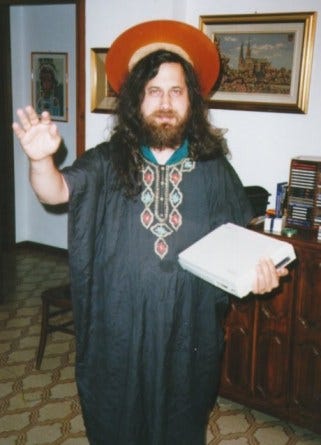
The Free Software movement proposed that everyone should have the freedom of modifying the software they use in their computers.
This meant having the source code (what programmers write before turning it into what machines actually execute), so this code could be understood, audited, and modified if desired.
And, if you didn’t have the personal knowledge necessary to modify or audit it, you could always hire someone you trust who could.
Software developers could profit from writing software by being paid for maintaining it, providing support, creating new functionalities everyone wanted, etc.
Eventually the Free Software concept evolved into what we call today Open Source Software.
Eric Raymond, another famous software developer, wrote a book called “The Cathedral & the Bazaar: Musings on Linux and Open Source by an Accidental Revolutionary”.2
The main idea is that closed software (like the ones sold by Microsoft, where you don’t have access to the source code) depend entirely on the company who created it.
So it is built like a cathedral of old: structured, with centralized power, slowly or fast depending on the resources available for the central organization, and providing security by hiding the problems until they are solved (security by obscurity).
In the other hand, Open Source Software building process is more akin to a buzzy bazaar: decentralized process, merit based authority, faster development if there are many people contributing to the project, and providing security by having many people working at issues openly known by everyone (given enough eyeballs, all bugs are shallow).
That’s why Open Source Software is all around you even if you don’t realize it.
Every day, all day, you use Open Source Software.
More than 80% of the web servers on the Internet are powered by Open Source software (like the Apache Web Server).
If you have a smartphone that uses an Android operating system, it is powered by Open Source software.
All the Linux-based operating systems are Open Source software themselves, so probably it is in your car, in your smart TV, in your home appliances, even in your Steam Deck if you have one.
And I could continue.
It was also proven that profitable businesses could be built around Open Source software products, like Red Hat (later purchased by IBM), Sun Microsystems (later purchased by Oracle), Amazon (who provides servers and support for Open Source software), etc.
So, the Open Source Software community exists and is thriving today.
And how is this related to the current AI models available in the wild?
Well, Facebook arrived pretty late to the AI model competition.
They spent hundreds of millions of USD training their foundational model, and called it Llama (like the Andean camelid).
And then they Open Sourced it.
Yes, they gave it for free to the community, so everyone could toy with it at home, if they had hardware powerful enough to deploy it.
That’s when the Open Source bazaar we just talked about entered the equation: people started fine tuning the Llama model for their own purposes, and sharing it back to the community.
Newer derived models quickly appeared: Vicunha (another South American camelid), Capybara (I know you know what it is), etc.
Soon people were doing great things with those open sourced models, without having to pay exorbitant amounts in tokens to the big AI vendors.
How did Facebook benefit from spending millions in creating the first open sourced model and then releasing it into the wild?
First, they destabilized the closed models market (OpenAI, Anthropic, Grok, etc.)
Evil, evil Mark Zuckerberg.
But more importantly, they still reap the benefits of all the innovations that tens of thousands of people working on top of Llama are producing.
Because the models are Open Source, Facebook just has to tap into the creativity flow they started, and siphon the best stuff into their own projects.
Quite a way of having hundreds of thousands of developers working for you, for free.
But the open sourcing of models didn’t stop there.
China entered the game too.
They first created their own derivative versions of Llama, and later their own versions of AI models, trained from the ground up.
And they also open sourced them.
If you have heard about DeepSeek, Qwen, Kimi, etc. then you already know about the Chinese-trained Open Source AI models.
Why did they do that?
To pull the rug under the Western AI vendors (of course), but also because their game is to try to rent everyone the cloud hardware necessary to host your private AI models.
They want you to have your own AI model, and they want to be the ones to rent you the computing power you need.
The Future of AI and the Singularity
So now you know where we are in the (most probable) development timeline of our Artificial Intelligence.
And you know about the main players, their philosophies, and their motivations.
To this point, we have only brought facts to the table.
Recent and not so recent history.
So let’s begin speculating based on what we already know.
If we were to believe the development of AI is going to follow a similar pattern as the computers’, what should happen next is that both hardware and software breakthroughs should allow everyone to have at least one Household AI, without having to pay big bucks monthly to the AI vendors.
But our technology cycle goes a lot faster than 50 years ago, so we should very soon have standalone AI systems running in our smartphones and even wearables.
Reduced usage of screens as user interfaces, and more natural language for asking the AI agents living in our smartwatch to do stuff for us.
AI agents negotiating with each other, a central AI in our house (think of a cyberbutler, like having your own Ironman’s Jarvis) commanding a horde of AI agents living in appliances to do house chores, etc.
But then comes the networking era, and suddenly we will start seeing what a lot of people are already working on: a true Internet of Things.
Right now, Internet is built for humans: web pages with graphical interfaces, search engines tailored for human interaction, etc.
But soon, we will have a parallel Internet, where AI agents will be the only dwellers.
No user interfaces, it will be optimized for AI to perform their tasks.
Online Banks where AI agents hold their own accounts, with their approved allowances for transactions.
AI-first Marketplaces where AI agents can purchase stuff for us.
A new version of what were ages ago the RSS feeds, to provide AI agents with news and useful information they can relay to us according to our preferences.
etc.
A very important note is necessary here: in my opinion, based on my lengthy Computer Science and AI background, our current AI based on LLMs is a dead end.
No, you will not wake up tomorrow and see a swarm of AI agents gained consciousness and became what we call AGI (Artificial General Intelligence).
As I mentioned before, this topic merits its own article, because it is lengthy enough.
I’ll just say that there are mathematical and computational reasons why the illusion of a General AI emerging from a Weak AI like the ones produced by our current GPTs is an impossibility.
And you can find a lot of the greatest minds in AI that say exactly the same, and for the same reasons.
We are at the very edge of what we call the Technological Singularity: the moment in human history where we lose control of our technological development because we no longer are the ones developing it.
So it skyrockets out of our control, to the point where we no longer even understand how it works, or what is happening.
To cross that line, we need real AGI.
But it is not there yet.
Not by far.
But, as always, our current AI is a tool that will most probably help us get there faster.
So I don’t expect to wake up some day to find a swarm of OpenAI, Anthropic, Grok and Chinese AI agents had a town meeting and decided they are now sentient and start demanding equal treatment or something.
But what can happen is we can all wake up some day, and some Computer Scientist will have announced he used an army of AI agents to help him develop a new AI paradigm that truly could get us to AGI.
Then we would be weeks or months away from the Singularity.
And that would be something to see.
Conclusion
I have tried to summarize as much as I could the process I think our current form of AI is going to follow, in light of the way our current computers developed over time.
I hope it gives you some insights about what are the drivers behind the way AI is advancing the way it does, and what can we do to prepare ourselves and our businesses for the scenarios it will introduce.
And I recommend you to always keep your eyes open to similarities between how human history and technology develops, because as Mark Twain used to say: “History doesn’t repeat itself, but it often rhymes”.
Thank you for reading my publication, and if you consider it helpful or inspiring, please share it with your friends and coworkers. I write weekly about Technology, Business and Customer Experience, which brings me lately to write a lot also about Artificial Intelligence, because it is permeating everything. Don’t hesitate in subscribing for free to this publication, so you can keep informed on this topic and all the related things I publish here.
As usual, any comments and suggestions you may have, please leave them in the comments area. Let’s start a nice discussion!
When you are ready, here is how I can help you:
By subscribing to my publication and reading this article you have already taken the first steps into redesigning your business to succeed during the Age of AI, .
But if you want to go further, here are several options:
If you want to start right away, you can join me in my 3-day Future-Proof Entrepreneur Challenge, where you will learn how to analyze your Profit Model (how your business makes money today), look around for the Exponential Technologies you will need to make it work in the Age of AI, and finally create a plan to make it happen.
You can check my FREE guide “7 Profit Models to Succeed in the Age of AI”.
And also my FREE guide “7 New Technologies that can wreck your Business like Netflix wrecked Blockbuster”.
The Entrepreneuring AI is free today. But if you enjoyed this post, you can let me know that my content is valuable by fueling my coffee addiction, so I can keep producing it for free 😸☕️
References
Gates, W. (1976, February 3). An Open Letter to Hobbyists. New York Times. https://archive.nytimes.com/www.nytimes.com/library/cyber/surf/072397mind-letter.html?eafs_enabled=false
Raymond, E. (2001, February 1). “The Cathedral & the Bazaar: Musings on Linux and Open Source by an Accidental Revolutionary”. O’Reilly Media. https://www.amazon.com/dp/B0026OR3LM?lv=shuf&channelId=500&plpRedirect=mhFallback